
"Can I just cut the engine remotely?" is one of the first questions people ask when they're looking at a GPS tracker, and the honest answer is: yes, but not quite the way the movies make it look. There's no dramatic kill switch that stalls a moving car. There's a relay, a wire, and a decision about exactly when it fires. Here's how it actually works.
It's a relay, not magic
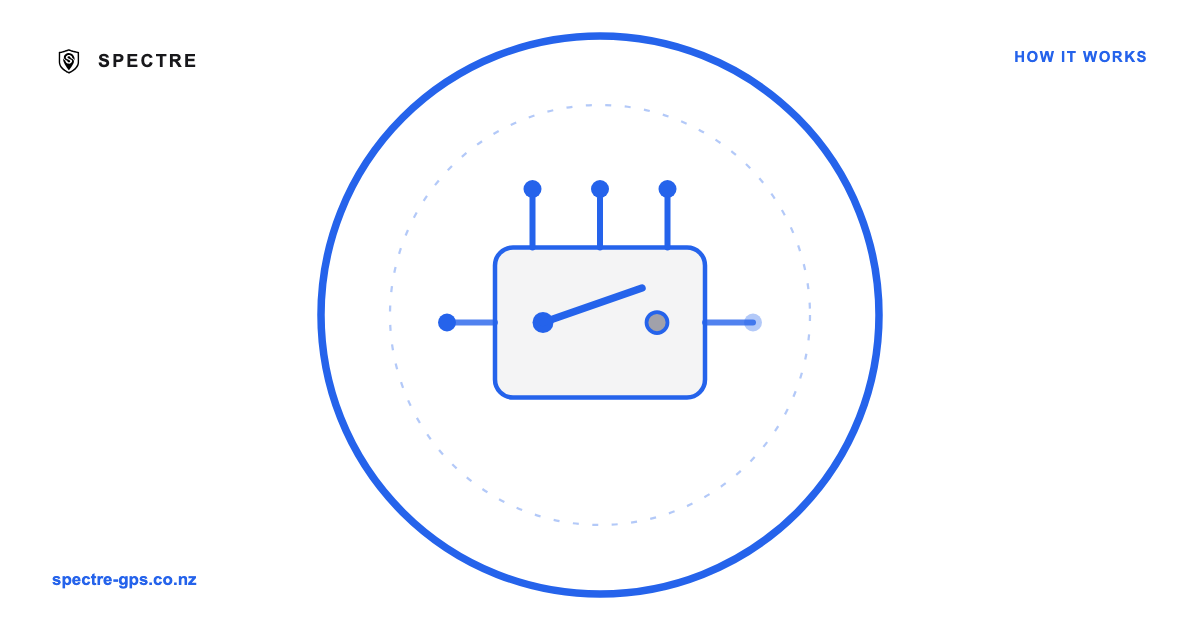
Every Spectre tracker - Basic, Advanced or Pro - ships with at least one output wire dedicated to this. When you tap "immobilise" in the app, the tracker sends a signal down that wire to a relay wired into the vehicle's ignition or starter circuit. The relay opens the circuit. The engine won't start, or won't stay running, depending on where it's wired in.
That's the whole mechanism. No software magically stops a running engine mid-drive - that would be lethal at speed, and no reputable tracker does it. What it does is prevent the next start.
Fail-safe by design, not by accident
The relay is wired normally-open, so the circuit is only live when the tracker's output is deliberately switched low. If the tracker loses power, loses signal, or the wiring fails outright, the relay defaults back to letting the vehicle start - not the other way around. A tracker fault should never be the reason someone's stranded on the side of the road. That's a design choice, not a limitation.
What actually happens when you use it
Vehicle's stolen, or you just want it grounded - a contractor's ute after hours, a fleet vehicle flagged for a compliance check, whatever the reason.
You open the app and tap immobilise. The command goes out over the same 4G connection the tracker already uses for live location.
The relay opens. Next time someone turns the key, nothing happens, or the engine cuts out within seconds of starting, depending on the wiring point.
You reverse it the same way, the second you want the vehicle drivable again.
It doesn't stop a vehicle that's already moving, and it's not meant to. It stops a stolen vehicle from being driven again once it's parked - which, paired with live location and movement alerts, is usually the part that actually gets it back.
Every tier includes it - the difference is what else you can wire in
This trips a lot of people up: immobilisation isn't a Pro-only feature. The Basic 4G ships with one input and one output, and that output is exactly this - a wired immobiliser relay. So does the Advanced 4G. The Pro 4G's real advantage is more inputs and outputs, for wiring in more than one relay, or an immobiliser alongside a siren, a lock, or a sensor. If all you need is tracking plus the ability to shut it down, the Basic 4G already does that.
Why it has to be wired in, not app-only
Some cheaper OBD2 plug-in trackers advertise remote immobilisation without any real wiring - which usually means it's not actually cutting the starter circuit at all, just sounding an alarm or sending an alert. A genuine immobiliser relay needs a physical connection into the ignition or starter line, which is exactly why Spectre trackers are hardwired rather than plugged into the OBD2 port. It's also why a professional install matters here more than almost anywhere else on the vehicle - get the wiring point wrong and you either don't get a real immobiliser, or you get one that fails unsafely.
Worth having on anything you can't simply replace
A ute, a boat, a classic that took years to restore - the value isn't really in what it costs to replace, it's that you often can't. Live location gets police to it fast. A wired immobiliser means that once it's stopped, it stays stopped, on your terms, from your phone.